Introduction
Zimbabwe, once a British colony, gained its independence in 1980. With its independence on the horizon, Zimbabwe also saw the emergence of their own currency ‘The Zimbabwean Dollar.’ The same currency would go on to become one the most inflated currencies the world has ever seen within a span of 25 years. This paper discusses the Hyperinflation Crisis of Zimbabwe which was at its peak in the years 2007 and 2008. The Crisis’ onset began in 2004 and ended by early 2010. At its highest, the inflation rates had reached a mammoth 230 billion percent in 2008. What followed was the discontinuation of the currency altogether and the restructuring of the economy. Now let us understand the genesis of the crisis which dates back to the 1990s.
Causes
Zimbabwe saw a strong rate of development and growth in its initial years after gaining independence. The Zimbabwean Economy was driven by agriculture, mining and manufacturing sectors. The agriculture sector was prominent where wheat and tobacco production were the highest. The time frame of 1980 to 1990 saw an average growth rate of 4.5% in Zimbabwe’s economy. The decade that followed saw a huge instability in the economy which would affect Zimbabwe to its core. Robert Mugabe, the leader of the nation, through his policies tried to bring changes which would not land well in the coming years.
From 1991 to 1996, the ZANU-PF government led by Mugabe initiated the Economic Structural Adjustment Programme (ESAP) which would have detrimental impacts on the nation’s economy in the future. ESAP entailed the reduction of Government expenditure by retrenching 25 percent of the civil service, withdrawing subsidies, commercializing and privatizing some state-owned companies and introducing user-fees in the health and education sectors, among others. The reasons why the ESAP was adopted by the Mugabe government in the first place were four: restrictions on investment, business and credit inefficiencies, a serious budget deficit because of high spending on social services, and unemployment. The idea behind the ESAP to help the economy was driven by the expectation that it would encourage growth, reduce government intervention in the economy, improve foreign exchange, and reduce budget deficit. The government also introduced Land Reforms which took away lands from certain classes of the society existing in Zimbabwe. This led to a fall in agriculture production bringing down the growth rate and worsening the economy.
Let us understand why the ESAP and Land Reforms failed to perform in an economy which was already growing. The first of the many problems were the droughts of 1992 and 1995 which hit the agriculture sector on the low. As agrarian product fell so did the economic growth. The second was the rising deficit which caused pressure on the government. Liberalization introduced through the ESAP was implemented quickly but failed to adapt to the economy. These problems caused output to fall drastically and slow down the growth rapidly. However, by 1996-97, it seemed Zimbabwe could increase its produce by a positive recovery. 1996 was also the year of elections in Zimbabwe. On one hand, the economy was reviving over the chaos created and on the other hand the government started spending lavishly to win the polls which would go on to restore Mugabe as leader of Zimbabwe. This made the deficit burgeon even further. This led to the withdrawal of the International Monetary Fund’s support to Zimbabwe. In addition to this, in 1998, the Zimbabwean army went on to invade Congo, which led even more expenditure by the government. The war with Congo resulted in draining of hundreds of millions of dollars for the government causing the economy to bleed further.
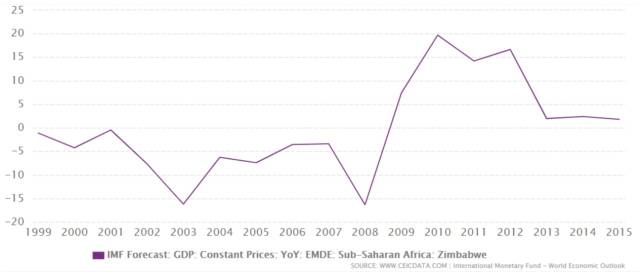
After the election restoring Mugabe’s leadership and the wars ending by 2000-01, the Zimbabwean economy was left in a devastated state. From 2000 to 2004, agricultural production went on to decline by 45% because of the land reforms made by the government. The manufacturing output was declining at a rate of 25% and unemployment rose to a mammoth 68%. The banking sector collapsed too, with farmers not being able to get loans for credit development. This caused the economy to decline with the rate rising each year: 5% decline in 2000, 8% in 2001, 12% in 2002 and 18% in 2003. The graph below explains the declining growth rates which went on to a record low by 2008 at the same time when the hyperinflation crisis was at its peak. Therefore, inflation can be directly linked to the Zimbabwean economy’s downfall.
The Hyperinflation Crisis (2004-09)
The state of economy was alarming and the people faced acute problems. The government had to come with a plan and it had to be quick. Therefore, the Zimbabwean government decided to print more currency to boost the economy’s performance. Little did they know, that this decision would bring down the economy even further in the coming years. The Reserve Bank of Zimbabwe started to print currency in massive amounts to help the government to manage the short run economy as well as help them in controlling the fiscal debt which was mounting up from the last ten years. Even after the intentions of printing currency was to stabilize the economy, the opposite was about to occur. As per the Monetarist view, inflation was directly related to money supply. The Quantity Theory of Money (QTM) invented by Nicolaus Copernicus in 1517 suggested that the general price level of goods and services is directly proportional to the amount of money in circulation, or the money supply. As suggested by the QTM, the hyperinflation in Zimbabwe originated due to the increase in money supply.
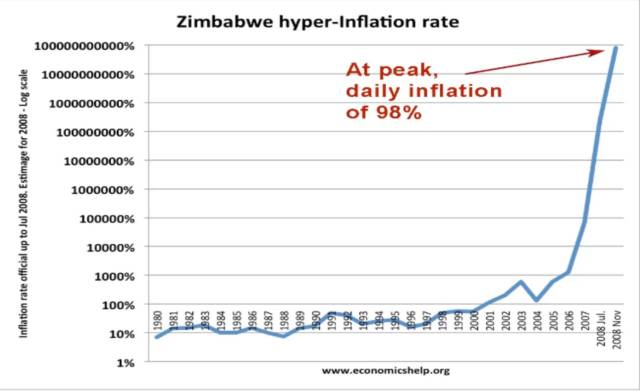 The graph showcases the inflation rate in Zimbabwe. As we can see, the rate of inflation remained more or less within a certain limit till 2002. However, by 2003-04 the graph starts to rise upward steeply. This is the same time period when the Reserve Bank of Zimbabwe started to infuse more money supply into the economy. What follows is the rising of inflation rate exponentially. By 2006, the rate had already rise to a 1000% and by 2008 the inflation rates reached a staggering 231 billion %. The Mugabe government could not realize the alarming rates on inflation and went onto print more currency. The currency notes went on to become worth 100 trillion dollars within a short span of couple of years. This type of magnitude in currency notes shattered the economy. On 1 March 2008, it was reported that documents obtained by The Sunday Times showed that the Munich Company Giesecke & Devrient (G&D) was receiving more than €500,000 per week for delivering bank notes equivalent to Z$170 trillion a week. Prices of household commodities, bus fares, and other daily items were rising multiple times in a day. The daily inflation rate made the credibility of Zimbabwean dollar shatter and people started to trade in foreign currencies. The hyperinflation state went on to decline the agriculture, manufacturing and mining sectors of the economy which were already in a bad shape. By 2008, it was clear that printing more currency was not viable and gained widespread media attention all over the globe. Corruption and inefficiency in the Mugabe government was prominent and international bodies IMF and World Bank could provide no further help.
Actions Taken to Curb Inflation
The hyperinflation crisis brought the Zimbabwean dollar to have zero value in foreign exchange markets. By late 2008, the government decided to ban the inflated currency in circulation and no further currency was infused. As the national output of Zimbabwe went to rock bottom, it started to import almost every good and service. The various actions taken to curb inflation by the government helped the economy to gain momentum once again. The government then resorted to the US Dollar becoming the official currency in Zimbabwe. This would help the economy to revive from the extensive damage witnessed. The government also banned inflation in 2008. Anyone who raised the prices of any good or service would be arrested. The government promoted the circulation of US dollars among daily markets and small-size vendors. It also set a limit on withdrawal of currency at a daily basis. The Reserve Bank of Zimbabwe worked on restructuring the currency several times and lay out a plan to make the currency more credible.
Imports from foreign nations was a helping hand and rose rapidly. The markets started to stabilize with the public spending mostly in foreign currencies like the US dollar, Euro and South African Rand. As we can see the graph given above, in 2008 the real GDP growth was at a record low of -15%. Through the various changes made by the government, the economy started to revive and within a year reached a positive growth rate. By 2009, the rate of inflation too started to drop.
Aftermath and Conclusion
The hyperinflation crisis finally ended by 2009 but the economy was still vulnerable. Imports remained to be high. The Mugabe government tried to promote economy by fixing the price levels. The central bank came out with a better currency circulation system and by 2014, Zimbabwean dollar was reintroduced. Inflation went on to decline by 2009-10 as the national output rose. The hyperinflation crisis was one of the worst inflation crisis in history. The inflation rates by 2010 reached around 4% and stabilization of economy was in sights. The economy has since then become more stable and as of 2017, the inflation rate was 4.3%. Zimbabwe could overcome one of the worst crisis resulted due to the high money supply that the government initiated.
However, in late 2018, the inflation rate began to rise once again and as of 2019 is predicted to be hovering around a 100%. One thing remains constant with the inflation crisis then and now: the government. Robert Mugabe, the leader of the nation from the last 38 years has helped Zimbabwe to rise, fall, rise and fall once again. The growth rates and inflation rates of Zimbabwe remain to follow the trends of that of a roller coaster ride. The political and economic stability of Zimbabwe remains uncertain. But till then it can be remembered for its fight against the worst inflation crisis of all time.
 hyperinflation in Zimbabwe